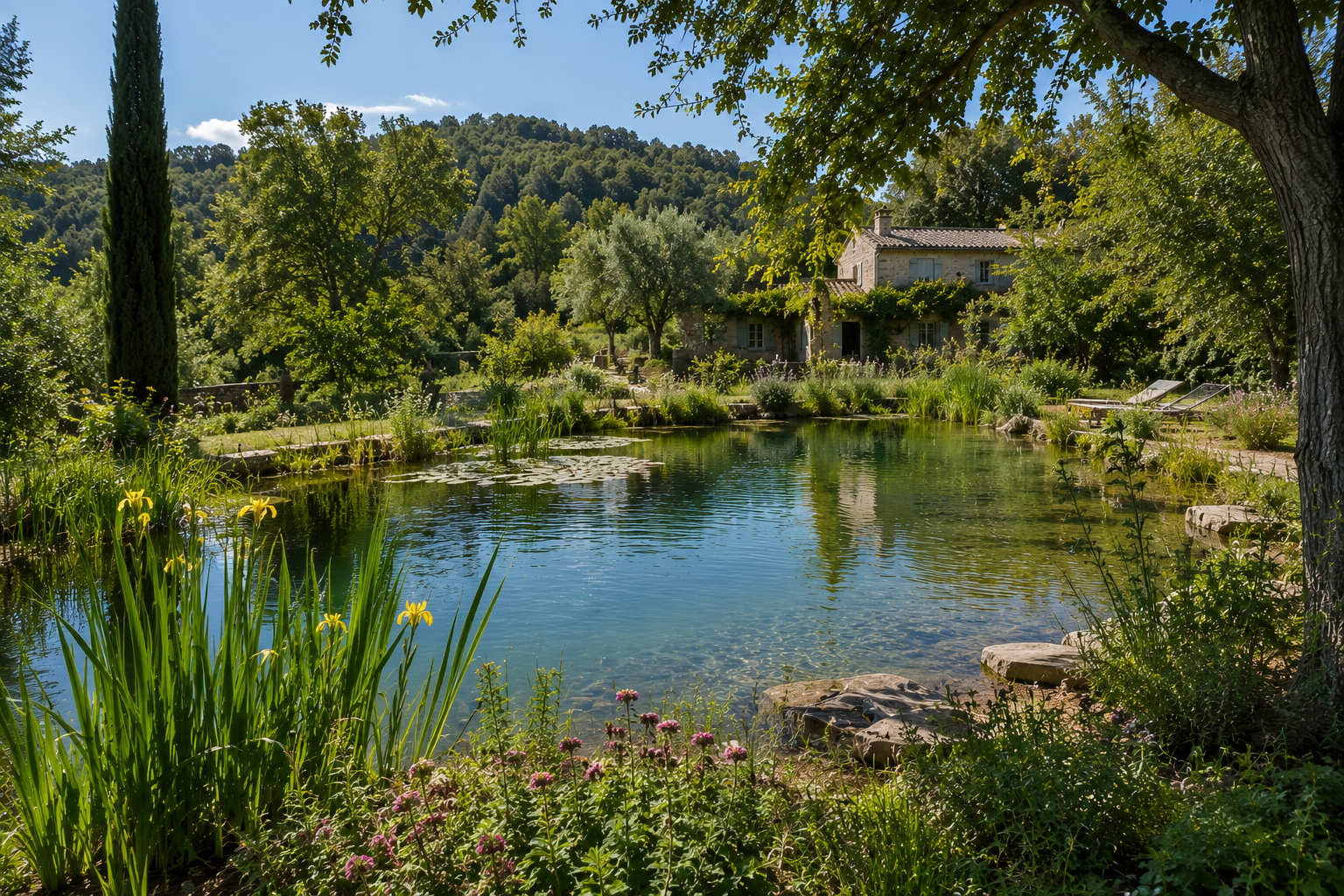
A pond or natural bathing area on a rural property is not merely a leisure facility. When designed with care, it becomes a landscape element that profoundly enriches the property — aesthetically, ecologically and experientially.
The different types of natural bathing
Between the biological swimming pond (where filtration is provided by a plant zone) and the simple ornamental pond (without a bathing zone), there is a range of intermediate solutions adapted to different budgets and uses: a semi-natural pond with biological filtration, a natural swimming pool with a liner concealed by plant growth, a spring-fed basin with natural flow. The choice depends on the site, the water table, the volumes available and the owner’s use.
Integration into the property
A natural bathing area should not be imposed on a landscape — it should emerge from it. The ideal location takes advantage of natural topography (a natural hollow, a gentle slope), the presence of existing trees (for shade and integration), the proximity of the house (for convenient use) while maintaining a sufficient aesthetic distance (to avoid a swimming pool effect). The shape, the materials of the edges, the choice of aquatic plants: everything contributes to an integration that is as natural as possible.
Ecological and regulatory aspects
The creation of a pond on private land may require a declaration or prior authorisation, particularly near watercourses or wetlands. A biodiversity impact study may be required. These administrative dimensions should be verified upstream of the project.
A lasting added value
A well-integrated natural bathing area is a genuine qualitative differentiator in the sale of a rural character property. It contributes to the aesthetic quality, ecological coherence and experiential dimension of the property — three criteria increasingly sought by discerning buyers.