
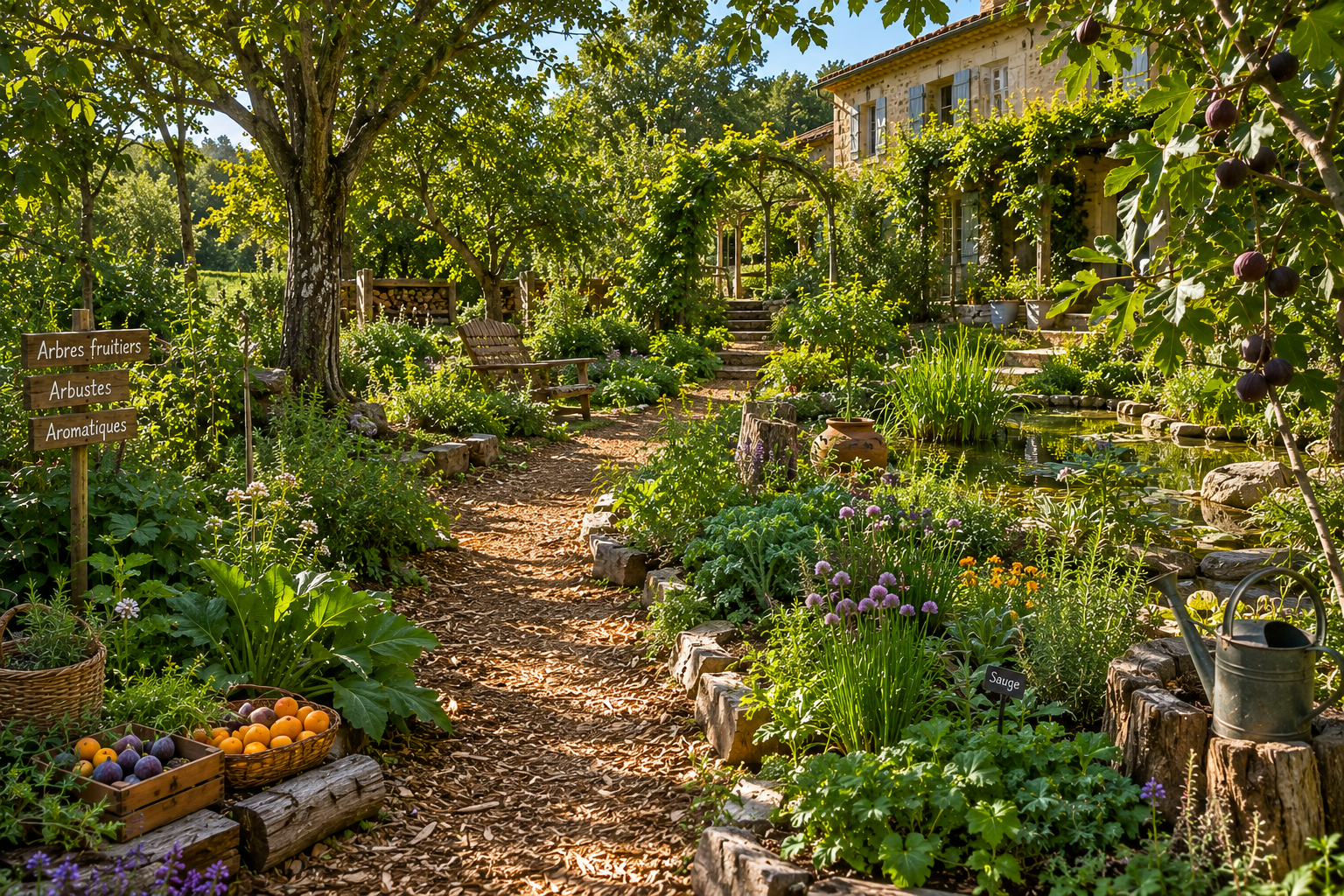
The forest garden — or food forest — is an increasingly considered approach for owners of rural character properties who wish to develop their land in a way that combines productivity, biodiversity and aesthetic quality.
The principle of the forest garden
A forest garden reproduces the structure of a natural forest in miniature, with several vertical layers: tall canopy trees, smaller fruit trees, shrubs, perennial plants, ground cover and climbing plants. This multi-layered structure creates a self-regulating ecosystem that requires little intervention once established.
Adapting the approach to a character property
In the context of a character property — bastide, manor, rural estate — the forest garden can be conceived as one zone among several, complementing a more formal ornamental garden, a kitchen garden, orchards or meadows. The key is integration: a forest garden that clashes visually with the architecture or the landscape history of the place loses much of its relevance.
Biodiversity as a quality criterion
A well-designed forest garden becomes, within a few years, a genuine ecological corridor: birds, insects, small mammals, amphibians, find there the conditions they need. For owners sensitive to this dimension, it is also a form of responsibility towards the local territory.
Practical aspects
Creating a forest garden requires careful species selection (adapted to soil and climate), initial investment in planting and layout, and several years of transition before the system reaches its cruising regime. It is an approach for patients — but one that rewards them in the long run with a remarkably productive and low-maintenance space.