
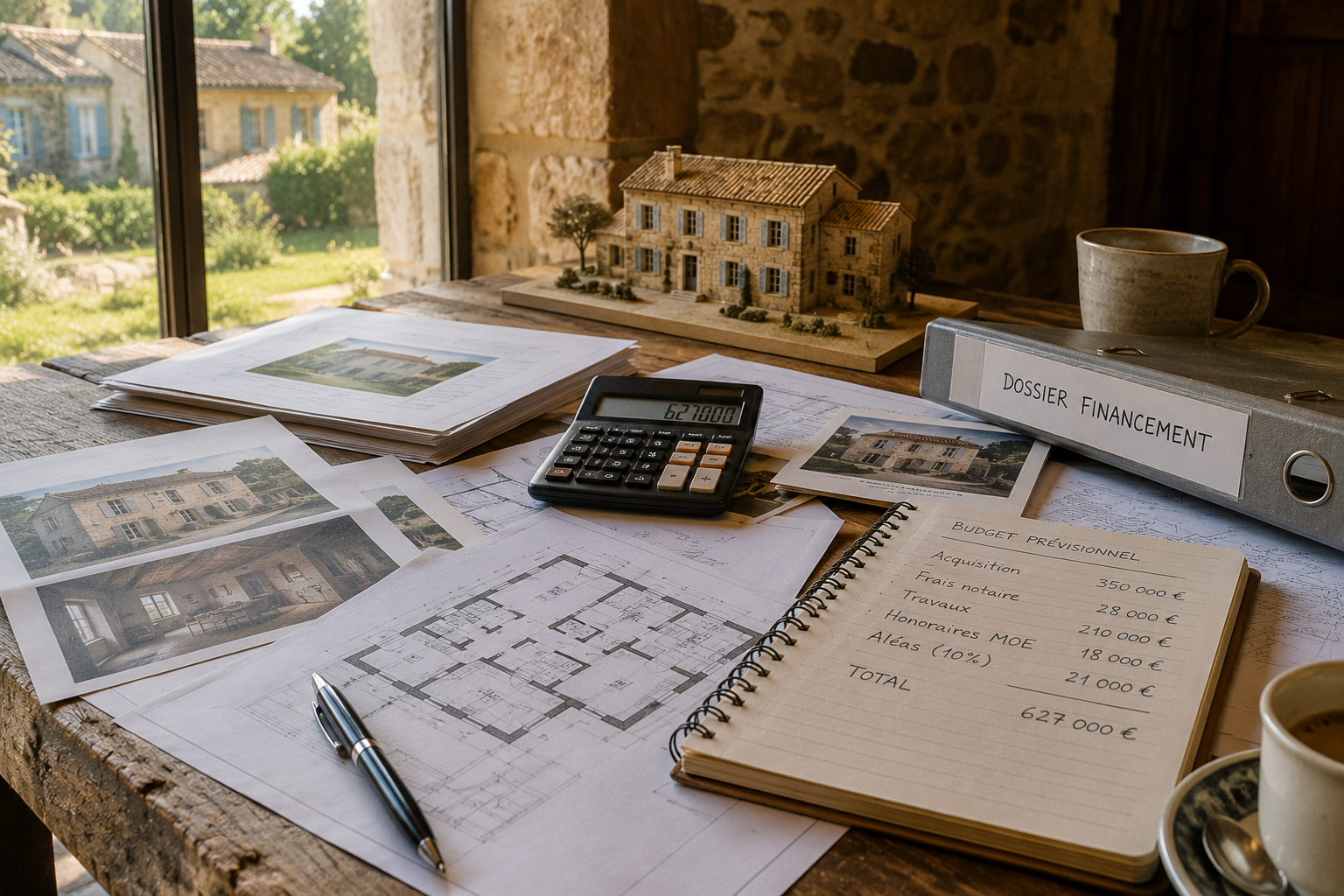
Financing a character property purchase involves specific challenges that standard residential financing does not always address well. Understanding these specificities in advance is essential to avoid unpleasant surprises.
Assessing the full cost of acquisition
The purchase price of a character property is only the visible part of the iceberg. The renovation budget, notary fees (which can be significant for old properties), agency fees, the cost of technical surveys and diagnostics, connection work for isolated properties, landscaping: the total cost of a character acquisition can easily represent 20 to 40% more than the purchase price alone.
Financing old and renovation properties
Banks assess an old property differently from a new one. Energy performance is increasingly a factor — a property rated F or G can limit financing capacity. Works requiring simultaneous financing with the purchase can be integrated into an overall loan, but the bank will often require detailed estimates and sometimes an architect’s validation.
The eco-PTZ and renovation schemes
For energy renovation work, the zero-rate eco-loan (eco-PTZ) can complement a classic mortgage without means-testing. MaPrimeRénov’ subsidies can reduce the effective cost of work. These schemes evolve regularly — it is advisable to verify current conditions at the time of the project.
Negotiating the right price
In the character property market, where properties are by nature rare and their value partly subjective, the negotiating margin can be significant — particularly if the property requires heavy work. A realistic assessment of the property’s intrinsic value, independent of the vendor’s emotional attachment, is an essential negotiating tool.
Cash buyers and their advantages
A significant proportion of international or wealthy buyers purchase character properties without a mortgage. This « cash » position is a real competitive advantage in negotiation — particularly on properties that have remained on the market for a long time. In these situations, the speed and certainty of closing are often worth more than a higher price.