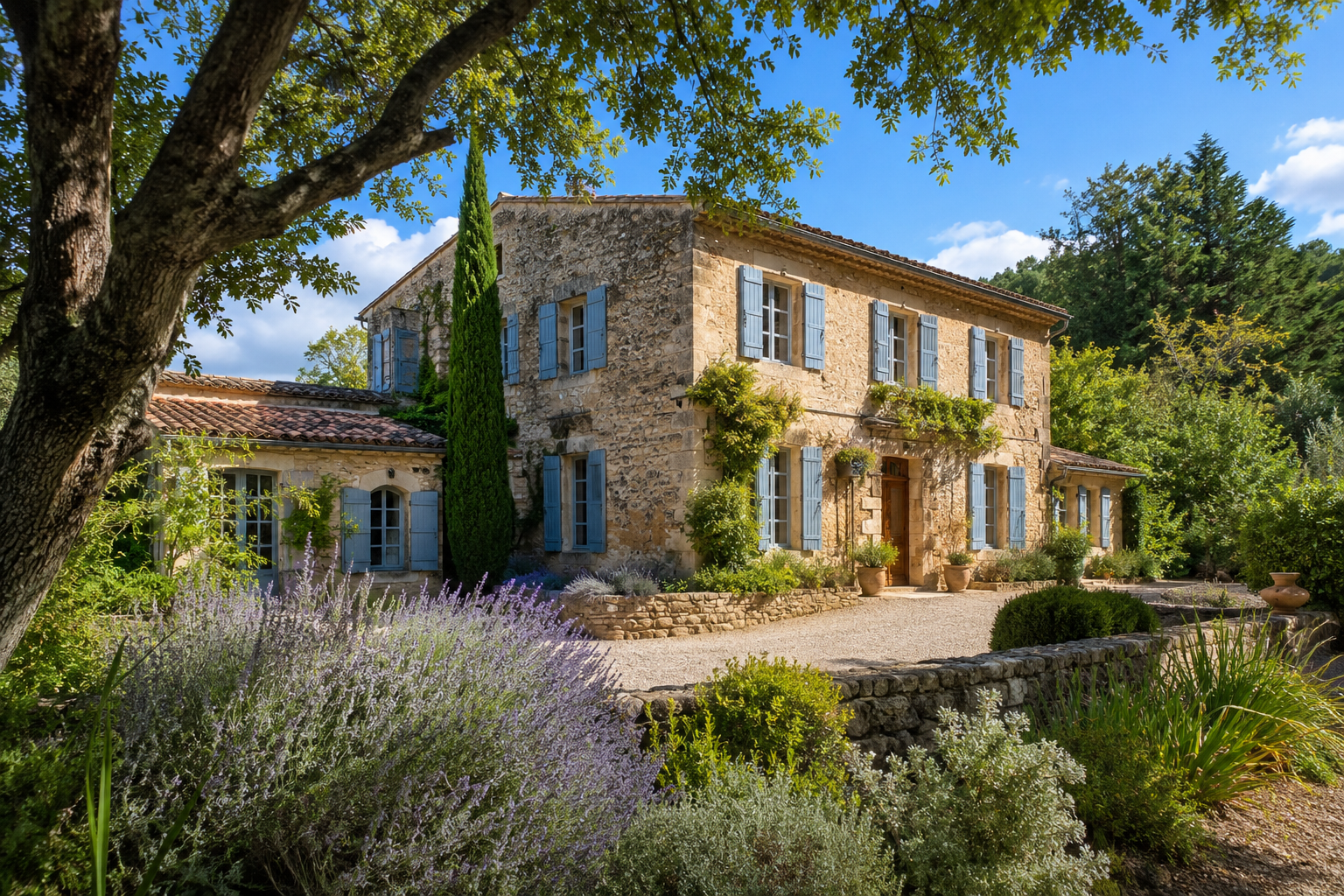
Bastides and Provençal villas represent one of the most distinctive elements of residential heritage in southern France. Far from the standardised property of the past few decades, these residences embody a particular way of inhabiting the land: an architectural language rooted in local materials, an orientation studied in relation to the sun and prevailing winds, and a relationship with the surrounding landscape that modern construction rarely achieves.
What defines a bastide?
The term « bastide » refers, in the Provençal and southern French tradition, to a rural or peri-urban property combining a main house with outbuildings, a courtyard and — often — an agricultural or ornamental garden. It differs from the simple farmhouse by its architectural ambition: larger openings, symmetrical facades, sometimes colonnaded galleries or a formal garden in the Italian style.
Provençal villas: a more recent typology
The Provençal villa emerged mainly in the late 19th and early 20th centuries, in the wake of aristocratic and bourgeois tourism in the region. Unlike the bastide — fundamentally rural — the villa is often peri-urban or coastal, with an architectural vocabulary influenced by Italian, Moorish or Art Nouveau styles. Many of them were the seasonal residences of wealthy families from Lyon, Paris or Northern Europe.
Character and market value
What gives a bastide or Provençal villa its character — and therefore a significant part of its market value — is rarely measurable by surface area alone. The quality of the stonework, the presence of original woodwork, the integrity of the garden design, the orientation, the view, the acoustic quality of the site: these are qualitative factors that an automated valuation tool cannot properly assess.
What to look for when buying
Acquiring this type of property requires particular vigilance: condition of the roof structure, quality of previous renovations, ground humidity, presence of protected trees or landscaping elements, legal status of outbuildings. A well-conducted acquisition involves visiting the property at different times of day and different seasons, and consulting professionals familiar with local heritage.