Feng Shui and character real estate share a common interest: the relationship between a place and those who inhabit it. How does this ancient approach apply to character properties in France?
Feng Shui: a brief introduction
Feng Shui is an ancient Chinese practice concerned with the arrangement of spaces to harmonise the circulation of energy — « chi » — and optimise the conditions for the well-being, health and prosperity of occupants. Beyond its traditional aspects, it offers practical analysis tools for any space.
Feng Shui and old buildings
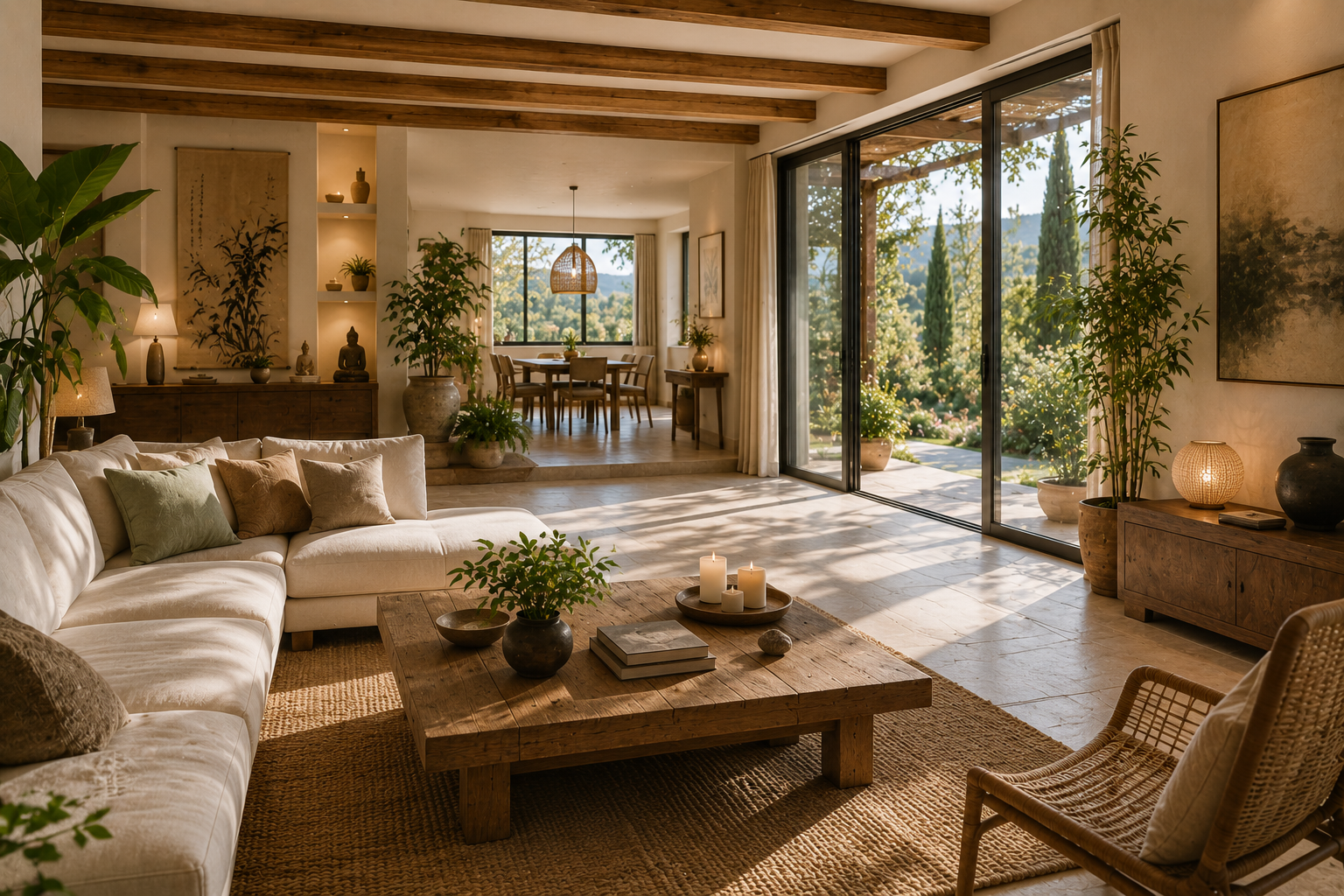
Old character buildings — stone farmhouses, bastides, manors — often naturally possess qualities valued by Feng Shui: thick walls that store freshness and protection, well-proportioned rooms, natural materials (stone, wood, terracotta), an orientation studied in relation to the sun and winds. These properties were built before the era of standardisation, at a time when the relationship with the environment was intuitive.
Common points of attention
Feng Shui analysis of a character property typically examines: the orientation of the main entrance (the « mouth of chi »), the relationship between the entrance and the back of the house, the circulation between the rooms, the quality of light in the main spaces, the relationship with water (fountain, pool, watercourse), and the management of dead angles or blocked zones.
A complementary tool
Whether one adheres to Feng Shui principles or not, its analytical framework draws attention to dimensions of a property often overlooked: the quality of circulation, the relationship between spaces, the management of shadow and light, the coherence between the building and its site. These dimensions, which directly influence daily quality of life, deserve to be taken seriously in the assessment of a character property.